A First Match on the Radio: Listen for the Shape
Follow a first football match on the radio by tracking the ball’s route, team shape, and the commentator’s clues, so each phase is easier to understand.

A first football match on the radio becomes easier to follow when you track where play moves instead of trying to imagine every touch. For a first football match on the radio, listen for the ball’s route, each team’s shape, and what changes when possession turns over.
Radio commentary leaves gaps. A pass may go unnamed, and a player may enter the story only when the ball reaches them. Treat the broadcast as a running field note: let each clear detail update your understanding, and leave uncertain details unresolved.
Track the ball’s route before building a picture
Before kickoff, catch the teams’ names and which end each attacks. Those are your anchors. When the commentator says a team is coming forward or playing toward the far end, you can place the movement without drawing a precise map in your head.
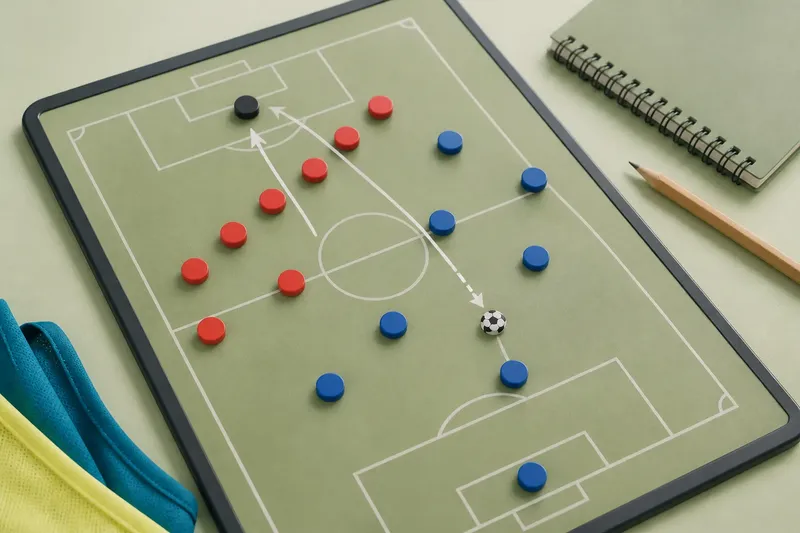
Follow the ball in broad strokes: from the back, into midfield, out toward a flank, or into the penalty area. “Switched across,” “knocked long,” and “worked down the left” describe a change in route. They matter more than the exact number of touches in between.
Keep a few location terms handy. “High up the pitch” means near the opponents’ goal; “deep” usually means nearer a team’s own goal. “Wide” points toward a touchline, while “through the middle” describes the central corridor. Commentary moves quickly, so keep the last clear location rather than inventing a detailed diagram.
After a burst of play, ask: Which end, and which route?
Read team shape from the commentator’s verbs
Action words often reveal how a team is moving. “Pressing” means players are closing down the opponent with the ball. “Dropping off” describes retreating to protect space nearer their own goal. “Squeezing up” means players are moving forward together and reducing the gaps between their lines.
Other phrases describe width. “Holding the width” means players stay near the touchlines to stretch the opposition. “Narrowing in” means they move toward the center, perhaps to crowd the ball or guard central routes. These are temporary clues, not fixed formations: a team can spread out during an attack and close in as soon as possession changes.
Listen for contrast words such as “but,” “now,” and “instead.” They often mark a shift. A side that was pressing may retreat after a pass beats the first line; a compact defense may spread out when it wins the ball and starts forward.
Say the commentator reports that the blue shirts are pushing up, but an opposing striker is running into the space behind them. The starting clue is the defenders’ high position; the next is the striker’s run. Put together, they suggest the attacking team is trying to exploit the room behind the advancing line, without requiring you to identify every defender.
Use sound to judge urgency, not the outcome
A rising crowd can signal a promising attack, a contested ball, or a shot. A sudden pause in the commentator’s pace may mean a player has time to choose a pass; clipped phrases often accompany a move developing quickly. These sounds suggest urgency, but they do not tell you by themselves whether a chance is clear or a goal is coming.
Notice what follows the noise. “Cleared away” means the immediate danger has been pushed out, not necessarily that the defending team has secured possession. “Still alive” or “back into the area” tells you the attack continues. After a whistle, listen for the referee’s decision before deciding why play stopped.
Names and descriptions can arrive late. The commentator may first say “the winger” or “the player on the near side,” then identify them once the move settles. Keep following the action rather than treating every unnamed figure as a missing piece.
If the sound gets crowded, wait for the next clear verb: passed, crossed, blocked, cleared, or saved.
Separate possession from a genuine threat
For a first listen, sort the action into three broad states: one team has the ball, the teams are contesting or changing possession, or one side is defending. You do not need to identify every transition instantly. “They’ve won it back” marks a change; “settling into possession” suggests the new holders are trying to control the next phase.
Possession is not the same as threat. A team can pass around the back without moving toward goal, while a quick forward ball can create danger before its team has held the ball for long. “Recycling it” usually means the attack has gone backward or sideways to begin again; “driving forward” signals an effort to advance.
This distinction explains why a commentator may sound excited even when no shot follows. A run into open space, a pass that breaks through a line, or a cross toward a waiting attacker can reshape the contest. The chance may fade, but the movement still tells you what the team tried to do.
What do common radio commentary phrases mean?
What does “winning it back” tell me?
It means a team has recovered the ball after the opponent had it. Listen next for whether the new holders pass forward, keep possession, or lose the ball again under pressure.
Why does the commentator mention a team dropping back?
Players may retreat to protect space near their goal or regroup after an attack breaks down. The phrase describes a change in position, not necessarily a decision to stop attacking.
What does “the press is beaten” mean?
The team in possession has moved the ball past opponents who were trying to close it down. Listen for the next clue: open space ahead, or another defensive line blocking the route.
How can I tell whether an attack is still going?
Listen for a clearance, a turnover, a whistle, or a phrase indicating that the ball has come back into the area. If none is mentioned, the move may still be developing after the crowd’s first burst of noise.
Let repeated patterns reveal a team’s plan
One phrase rarely explains a team’s approach. Repetition does. If the commentator keeps mentioning a wide player receiving the ball, a midfielder moving forward, or defenders stepping up together, you are hearing a pattern take shape. Remember the repeated action rather than assigning every player a permanent role.
Notice what happens when the same move is tried again. Does the opponent close the flank? Does the team switch to the other side? Does a forward run draw a defender away from the center? These adjustments make the match easier to follow as a sequence of choices, not just a string of shots and whistles.
Imagine you tune in while one team repeatedly sends the ball toward its right side. The commentator then says the opposing fullback has been drawn wide and a runner is moving into the middle. Starting with the repeated route, you connect the next two details: the defender moves outward, and the runner approaches the central space. The reasonable reading is that the attack is using the flank to create an opening inside; the tradeoff is that the picture remains broad, not a precise account of every player’s position.
For a first football match on the radio, keep one question nearby: What changed just before that? It turns a missed touch into a chance to hear the larger movement. Listen for routes, retreats, and shifts in shape, and the broadcast will give you a thread to follow even when the field remains hazy.