Advantage in Soccer: Why the Referee Lets Play Continue
Advantage in soccer lets play continue after a foul when that helps the fouled team. Learn when the referee may call play back and what happens next.
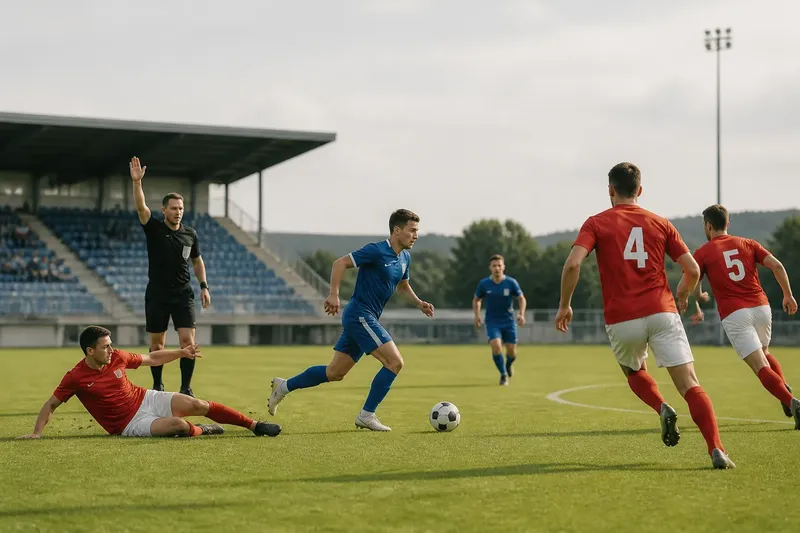
Advantage in soccer lets a referee keep play moving after a foul when stopping would hurt the fouled team more. Under Law 5 of the IFAB Laws of the Game, the referee may allow play to continue if the non-offending team benefits, then penalize the original offense if that anticipated advantage does not materialize at that time. That is a limited judgment under the Law, not an open-ended promise to revisit every lost attack.
Advantage in soccer weighs the live situation against the restart
The referee compares what the team can do with the ball now against what it would receive from an immediate free kick or penalty kick. Useful possession, a forward-facing teammate, open space, and defenders retreating may make continuation the better option. A loose ball likely to fall to an opponent may not.
Location matters, but it does not decide the question by itself. A foul near midfield might leave a teammate free to drive forward; a foul closer to goal might leave the ball crowded by defenders. The referee judges the immediate prospects, not just the address of the foul.
The signal—often an arm raised and a call of “advantage” or “play on”—shows that the referee has seen the incident. Players should keep competing, but the signal does not erase the offense or settle any disciplinary action.
The referee can return to the foul only within the Law’s timing
Law 5 says the referee may penalize the original offense if the anticipated advantage does not ensue “at that time,” or within a few seconds. It does not authorize a referee to wait indefinitely and bring play back merely because a promising attack later breaks down. The applicable Laws and the circumstances of the match govern the decision.
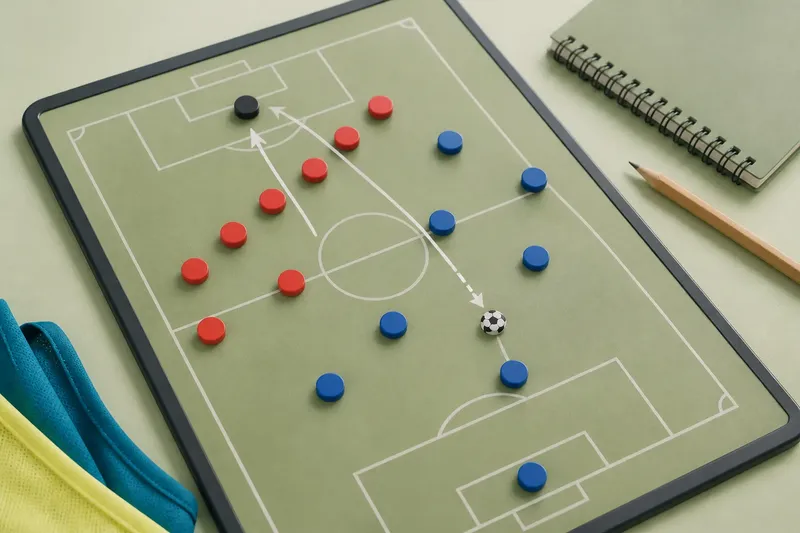
Say an invented match has Blue’s midfielder fouled near the center circle, while the ball rolls to a Blue winger facing upfield. Red’s defenders are retreating, and a Blue runner is moving into space. The referee signals advantage because Blue has a useful chance to continue.
The winger tries a through pass, but a Red defender intercepts it almost immediately, before Blue can develop the attack. In this invented sequence, the referee judges that the expected advantage has not ensued within the relevant few seconds and awards Blue a free kick at the original offense’s location. If Blue instead keeps possession and carries the move forward, the referee generally lets play continue; a later turnover alone does not mean the referee can call the original foul back.
The observable result matters: did the fouled team actually receive a benefit at the time, or did the anticipated opportunity fail to appear promptly? A missed shot or a later lost ball is not, by itself, a reason to rewind play.
Players and spectators can read the next actions
Players should continue immediately rather than stop to appeal. A teammate who hesitates can surrender the space that made advantage useful. Keep an eye on the referee, but play the ball unless a whistle stops the action.
Spectators can watch for retained possession, forward movement, and a receiver with room to act. Those details explain the referee’s choice better than judging it solely by whether the attack ends in a shot or goal.
Advantage does not erase a required sanction
Advantage concerns whether to stop play for the offense; it does not automatically cancel a caution or sending-off required by the Laws. The referee can apply the appropriate disciplinary sanction at the next stoppage, subject to the specific circumstances and the Laws governing that offense.
A serious foul or an offense denying an obvious goal-scoring opportunity can require a disciplinary response even when the referee allows play to continue. The referee weighs whether continuation benefits the fouled team while still managing the offense under the relevant Law. For a specific decision or competition rule, consult the current IFAB Laws and the competition’s guidance.
When can the referee bring play back?
Does advantage mean the free kick is waived?
No. If the anticipated advantage does not ensue at that time or within a few seconds, Law 5 allows the referee to penalize the original offense. If the team gains a real benefit, the referee does not generally return to the foul simply because the attack later ends.
Does the team have to score for advantage to count?
No. Maintaining useful possession or developing the attack can provide an advantage without a shot or goal. The referee assesses the benefit at the time, rather than treating the final result as the test.
Can the referee allow play after a serious foul?
The referee may allow play to continue when doing so benefits the fouled team, while still applying any required discipline. The nature of the offense and the relevant Law shape the decision.
Why might the referee whistle while the ball is loose?
A loose ball may be more likely to reach an opponent than the fouled team, leaving no useful opportunity to continue. If stopping offers the better restart, the referee can whistle rather than wait for possession to settle.
Judge advantage by what happens at the time
Advantage in soccer is a comparison made in live play: stop for the offense, or preserve a better opportunity for the fouled team. In the invented Blue sequence, the winger’s space justified continuation; the immediate interception gave the referee grounds to consider the original free kick under Law 5’s timing.
When an arm rises after a challenge, watch the next few seconds and ask whether the fouled team actually gained a useful opportunity. That distinction helps separate a disappointing later outcome from an advantage that never materialized in time.