Why Teams Leave Space Behind a High Line
Why teams leave space behind a high line: learn how pressure, timing and recovery shape the risk, and what to watch when opponents break through.
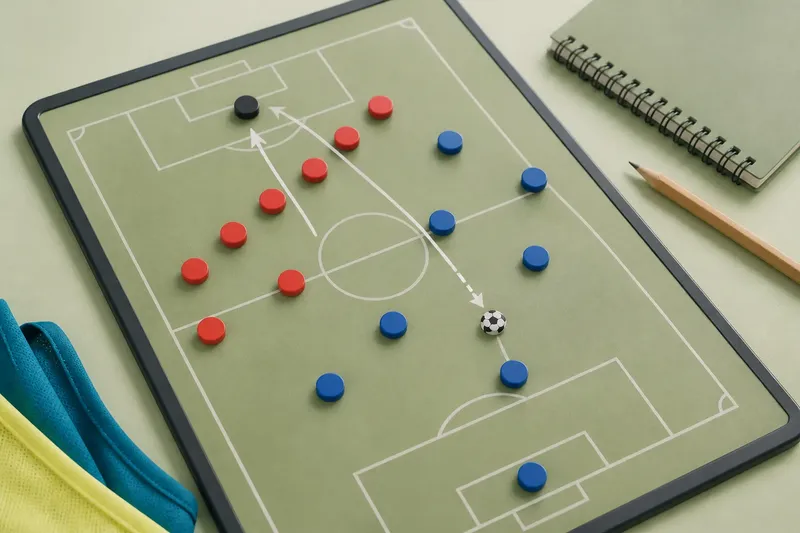
A high defensive line leaves grass behind the center-backs so the team can crowd the ball higher up the pitch. That trade-off is the point: defenders can squeeze passing lanes and support pressure, but one well-timed pass may send an opponent running toward goal. To read the tactic, look at how the line handles the problems that follow.
A forward pass keeps finding a runner
This usually means the defenders are stepping up without enough pressure on the player who can pass. A high line depends on the ball carrier having little time to look up and choose a pass. If that player can turn freely, the space behind the defense becomes an inviting target.
Notice whether a forward or midfielder closes down the passer, and whether the nearest defender is positioned to block the direct route. The line itself is only one part of the pressure. If the press arrives late, defenders may need to drop a few yards rather than continue stepping forward as a group.
Imagine a center-back advances to meet a striker, but the opposing midfielder has time to lift their head. The next pass goes into the channel behind the advancing defender. If the defending midfield closes the passer sooner, the expected change is less time for that pass to be shaped—not the disappearance of the space.
The back line steps up at different moments
A line that moves unevenly can leave a runner onside even when most defenders have pushed forward. This often happens when one defender is watching the ball, another is tracking a forward, and a third is reacting to a teammate’s movement. Their individual choices may make sense, but the group loses its shared reference point.
Watch the defenders’ shoulders and feet as the ball travels across the pitch. A coordinated line tends to shift together, with players checking both the ball and the attackers rather than staring only at one. A leader may call the movement, but communication works only if teammates respond at the same time.
If one player repeatedly holds the line deep, the rest may have to adjust their starting positions or agree on a clearer cue for stepping up. The useful question is not simply who made the error, but what sightline or signal would help the whole unit move together.
A quick pass splits the center-backs
When the center-backs leave a large gap between them, a pass through the middle can be as dangerous as a ball over the top. The cause may be excessive width, a defender following an opponent too far, or uncertainty about who should challenge the ball. A high line stretches the defense vertically; it should not also become loose across its center.
Check whether the fullbacks are narrow enough to support the center-backs and whether a holding midfielder is guarding the space in front of them. That player can obstruct a direct pass or slow the receiver while defenders recover. If the center-backs are pulled apart, compact support nearby matters more than simply telling them to stand higher.
One missed challenge turns into a footrace
A team may press well and still lose the first duel. The risk grows when the nearest defender dives into a challenge, misses, and leaves a teammate facing an attacker with open space to accelerate into. The problem is not that a high line has no recovery plan; it is that the first defender may have committed without cover.
Look for a second defender positioned to delay the runner rather than chase the same ball. A center-back can angle their approach to steer an attacker toward the touchline, while a fullback or midfielder tracks the next passing option. That buys teammates time to recover and narrows the attacker’s choices.
A quick retreat can be sensible after pressure is beaten. The line’s purpose is to control space as a unit, not to keep stepping forward at any cost.
The goalkeeper cannot sweep the ball
Space behind defenders is less exposed when the goalkeeper is positioned to reach through balls before attackers do. If the keeper stays close to the goal line, the defenders may be forced to defend both a long pass and a sprinting opponent without help. A high line therefore asks the goalkeeper to read the flight of the ball and judge when to leave the penalty area.
Watch where the keeper stands when the team has possession and when the opposition settles on the ball. A proactive starting position can shorten the distance to a pass behind, but it also means the keeper must judge the pass accurately. If the keeper stays deeper, defenders may need to retreat earlier or apply more pressure to the passer.
Which signs show the line is working?
Why do defenders stand near the halfway line?
They are trying to reduce the space between the defense and midfield, making it harder for opponents to receive comfortably between the lines. A higher position can also keep more teammates close enough to contest a loose ball.
Why does the line sometimes drop suddenly?
Defenders may retreat when the passer has time to play forward, when a runner gains a head start, or when the goalkeeper cannot reach the ball first. Dropping together can protect the space behind rather than concede an uncontrolled sprint.
What should I watch after a pass goes over the defense?
Check whether the passer was under pressure, whether the defenders moved together, and whether the goalkeeper came off the line. Those details help distinguish a coordinated risk from a breakdown in timing or cover.
Does a high line always mean a team is attacking?
No. It can be a defensive choice that keeps the team compact and limits opponents’ room in midfield, even when the team does not have the ball. Its success depends on pressure, coordination and recovery support.
Read the pressure before judging the risk
A run into the space behind a high line looks dramatic, but the pass often tells the fuller story. Was the passer free to look up? Did the defenders step together? Was the goalkeeper ready to sweep, and did a teammate cover the first challenge? These cues show whether the team chose a calculated trade-off or lost control of the situation.
When watching a match, follow the ball carrier and the back line at the same time. The space behind the defense is always there; what changes is how much time and support the opponent has to use it.